Showing posts with label Vacation. Show all posts

Monday, 30 June 2025

Travel Across the Border

One of my bloggers recently remarked that I must be the only Canadian he knows crossing the border into the USA these days. Well, not quite the only one, there were 26 of us on the Big Red Bus. (Although it seats 48 I believe. There were cancellations.)


We crossed into USA at the Peace Bridge at Fort Erie/Buffalo, no problems at all with the Customs Officers, everything went smoothly in spite of all sorts of stories about people being refused entry. We stopped at the Duty Free, and it was interesting to note we were the only bus in the big parking lot, along with 4 or 5 cars..... usually the place is thronging with shoppers. Nobody is travelling to USA.

When our Big Red Bus drove into the driveway at our hotel on Cape Cod in Eastham, Massachusetts, this is the scene that greeted us.


What a wonderful welcome! The Cape Cod area exists on tourism during the summer months, and although there were loads of Americans enjoying the area, Canadians are sorely missed. In many restaurants we were asked "Where are you folks from" and when we replied Toronto Canada, we heard lots of "Welcome! So glad you are here! Tell all your friends! etc etc" We heard heartbreaking stories about hundreds of hotel cancellations, and loss of income. And all because of one person. Sad.

Monday, 5 August 2019

Back to St John's

I was away from home for a couple of weeks in July and then, when I came back, the blogging mojo seemed to get overwhelmed with other stuff. But here goes....
I was in my favourite place... the city of St. John's on the rocky island of Newfoundland on Canada's east coast, house sitting and cat sitting for vacationing relatives.
And here are the cats, Captain Bob Bartlett (the saucy white one with a tiny paper heart stuck to his nose!) and Miss Thing (the serious one). They live together but they don't really like each other.

St John's has become a favourite vacation destination in recent years, probably due to a very active and innovative Tourism Association. The place was bustling with people from "away".  There are very few flat roads in the downtown area. This city was built on steep hills surrounding a deep harbour.  I seemed to be walking uphill all the time!  Good for the legs.  The downtown houses are mostly built of wood, and are painted some wonderful colours.... have a look.


Perhaps some of my photos may persuade you to visit Newfoundland one day.... it's such a beautiful place. More pictures to come, and for previous year's visits to St John's just click on the Newfoundland link below.

Wednesday, 5 December 2018

Wandering in St Johns

The Anglican Cathedral of St John the Baptist stands at 16 Church Hill in the city of St Johns, Newfoundland. There's a small entrance on Gower Street between Church Hill and Cathedral Street. That's the entrance I used when I went in to look at the inside.

The Cathedral is the mother church of the Diocese of Eastern Newfoundland and Labrador.
This is the main entrance on Church Hill. And this is where you would go to meet up with the St Johns Haunted Hike.
 As you can see, Cathedral Street is pretty steep.
This parish was founded in 1699. At least six wooden churches have stood on this site, destroyed by accidental fire, military operations or the rigorous Newfoundland weather. And before the churches, the land was used for public hangings up to the 1750s. The first stone church was begun in 1843, but only got as far as the cornerstone being laid. The present Cathedral was begun in 1847. The Nave was built 1847-1850, and served as the whole cathedral for the next 35 years, when the Chancel, Transepts and Sanctuary were added 1880-1885.
The Great Fire of 1892 caused extensive damage to the Cathedral and destroyed most of the town, leaving 11,000 people homeless. The roof timbers ignited causing the roof to collapse, and bringing the walls down with it. The heat melted the lead in all the stained glass windows except one, which can be seen in the Sacristy. The Cathedral was restored 1893-1905.
Looking towards the Cathedral from the back of the Masonic Hall, the red brick building on the right. These photos were taken in July sunshine. I think there would be some snowflakes flying today!

Sunday, 23 September 2018

Newtonmore, Scotland

We stayed three nights in the delightful small town of Newtonmore in the Highlands. In the centre of the town, there's a small lake.... called a loch in Scotland. Loch Imrich. The loch is a kettle-hole formed by glacial action during one of the ice ages. For many winters the pond was used for the sport of curling, but now there's curling rink in the village.
We walked the trail around the edge of the loch.... a lovely place to spend a quiet hour.

Digitalis purpurea. Foxgloves can be either purple of white. The flowers are always growing on one side of the stem on the wild plant. If the flowers surround the stem, then that is a garden variety.

The leaves and flowers of foxglove contain the spiro-steroid, Digoxigenin, used in biochemistry and immunohistological diagnosis. The compounds digitoxin and digoxin are used to make the drug digitalis, used as a heart stimulant. When I was little, I put the flowers on my fingers, but the flowers were traditionally known as poisonous, and Mum made sure I always washed my hands thoroughly afterwards.

Iris pseudacorus, or otherwise known as Yellow Iris or Yellow Flag. Lots of them growing along the edges of the loch.

I think this is Caltha palustris, Marsh marigold, also known as Kingcup. This plant contains a toxin that the old time herbalists used to remove warts. I'm not sure about this identification.


Saturday, 15 September 2018

Elgin Cathedral

Elgin Cathedral is known as "The Lantern of the North" and is one of Scotland's most ambitious and beautiful medieval buildings.
Begun in 1224, Elgin was the principal church of the bishops of Moray. The cathedral was damaged by fire in 1390, following an attack by Robert III's brother Alexander Stewart, Earl of Buchan, who was also known as "The Wolf of Badenoch".
The cathedral lost its roof shortly after the Protestant Reformation of 1560, and later its central tower fell. 
But the cathedral’s fortunes began to change when it became a visitor attraction in the early 1800s. There are guided tours around the ruins but I just wandered around enjoying the atmosphere.

Wandering in a graveyard may sound gruesome, but I loved seeing all the old grave markers and trying to imagine the lives of the people who lived in this community and came to this cathedral to worship. The tombstones tell so many stories.


 This saucy little fellow was found hiding behind a wall when some restoration was going on. Make sure you read the explanation in the next photo. And before you ask.... yes, I looked, of course I did, and yes.... anatomically correct!


Wednesday, 12 September 2018

Images of Scotland

Of course, any trip to Scotland always involves the sounds of a true Scot playing the bagpipes. This piper was busking on the Royal Mile in Edinburgh.
 The Royal Mile is the main tourist destination in Edinburgh so of course, there are all sorts of shops selling Scottish "stuff". Woolly hats and scarves, Scottish flags, whisky flavoured chocolate, fluffy toy lambs and highland cattle. Lots of these whisky shops, with many different single malt Scotch products for sale. I'm not much of a drinker, and I don't think I have tasted Scotch at any time during the last 30 years.... however visiting Scotland meant that I had to try a sample (or two!), and you know what? The stuff's not as bad as I thought it was going to be!

Scotch doesn't simply come in bottles.... here's a glass stag full of the stuff. You can take this home for 300 pounds. Good luck carrying it on the plane though.
And here's the real thing. The Monarch of the Glen by Sir Edward Landseer, painted around 1851 and currently on display at the Scottish National Gallery in Edinburgh. Magnificent!
The Monarch of the Glen is one of the most famous British pictures of the nineteenth century; for many people it encapsulates the grandeur and majesty of Scotland’s highlands and wildlife. Here Landseer depicts a monumental and precisely defined ‘royal’ or twelve point stag – a reference to the number of points on its antlers. Many of his paintings show interactions between humans and animals, but in this, his most well-known work, a single emblematic creature is viewed in a moment of exhilaration. It became widely admired in nineteenth century, when it was reproduced in prints, and achieved even greater renown in the twentieth century when it was employed as a marketing image for various products, so endowing it with global recognition.

Tuesday, 21 August 2018

The Kelpies

According to ancient Scottish legends kelpies are shape-shifting water spirits who inhabit the lochs and waterways of Scotland and appear most often as a horse, although they can appear in human form too, but can be recognised by water weeds in their hair.

A common theme in the Kelpie stories is of several children clambering onto the creature's back while one child remains on the shore. Usually a little boy, he then pets the horse but his hand sticks to its neck. In some variations the lad cuts off his fingers or hand to free himself; he survives but the other children are carried off by the kelpie and drowned, with only some of their entrails being found later. Gory!

These Kelpies are better behaved than that.

These Kelpie statues stand 30m tall (around 100 feet) and weigh over 600 tonnes.  Designed by Scottish sculptor Andy Scott and completed in October 2013, the Kelpies stand in the Helix Park in Falkirk. They pay tribute to the working horses of Central Scotland.


Each Kelpie contains 3,000m of steel tubing and 17,000 components, and the whole sculpture cost around 5 million pounds to build.


And I wonder what the Kelpies would look like under the surface......
One of the most astonishing sculptures I have ever seen. 

Saturday, 18 August 2018

The Forth Bridge

On the way out of Edinburgh we stopped for a photo op at the Forth Rail Bridge.


The Forth Bridge is a steel cantilever railway bridge spanning almost 2.5 kilometers. Construction started in 1882 and it was opened by the Duke of Rothesay (later to be crowned King Edward VII) in 1890.
Before the opening of the bridge, the rail journey from London to Aberdeen took about 13-1/2 hours. Once the bridge was in place, the journey was reduced to around 10 hours.
When I was at school I was taught that once the bridge was painted from one end to the other, it was time to start painting it again. "Painting the Forth Bridge" is a colloquial expression for a never-ending task, but in 2011, the bridge was covered in a new coating designed to last for 25 years. Paint crew no longer needed!
As a child I couldn't understand why the bridge was called the "FOURTH Bridge" when there were only three sections..... of course it wasn't "FOURTH", it was "FORTH".... as it crossed the Firth of Forth.

Tuesday, 14 August 2018

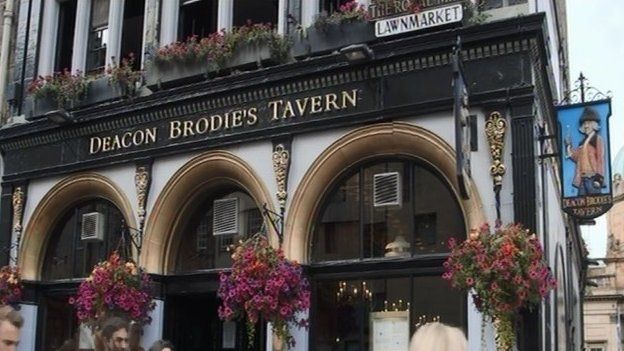
Deacon Brodie

Deacon Brodie's Pub is a popular watering hole on the Royal Mile in Edinburgh.
But who was Deacon Brodie?
This story is unashamedly borrowed from a BBC article about him.


On 1 October 1788 William Brodie was hanged for theft in the Lawnmarket, Edinburgh, in front of a crowd that was the largest seen in living memory. He strode out to the gallows in fine clothes and a powdered wig. He was 47 when he was hanged and until his arrest had managed to maintain the illusion of being a respectable craftsman.

The prestigious title of deacon did not refer to religion, as many assume, but instead to his presidency of one of Edinburgh's trades guilds. His trade was a cabinet-maker and his position as deacon of the Incorporation of Wrights made him a member of the town council.

pubPossibly Brodie's double life was the inspiration for Edinburgh author Robert Louis Stevenson's infamous character Dr Jekyll and Mr Hyde, which was published a century later.

Both Brodie's grandfathers were renowned Edinburgh lawyers and his father was a successful businessman. Brodie himself was a fine craftsman specialising in domestic furniture such a cupboards and cabinets. He was also a talented locksmith. Through his work he had access to the houses of very rich people and was able to make impressions of keys which meant he could come back at night and rob them. His criminal career began in 1768 when he copied keys to a bank door and stole £800, enough to maintain a household for several years. But it was not until more than a decade later that Brodie's crime spree got going properly.

Brodie's father died of palsy in 1782 and left him £10,000 in cash alone, a fortune in those days, plus at least four houses and the business. Brodie had been a member of The Cape, the most exclusive club in Edinburgh, but over time his interests turned to a disreputable tavern in Fleshmarket Close, which was notorious for late-night drinking and gambling with cards and dice. He was also keen on betting on cock fighting. In addition to his gambling, he was also supporting two mistresses (who didn't know each other!) and five children. He ran up debts during the night but his daytime business was thriving

In the summer of 1786 Brodie met an Englishman, George Smith, a locksmith who ran a grocers shop in the Cowgate. The pair soon became extremely busy targeting businesses and private homes in the Old Town. Towards the end of 1786 Brodie and Smith robbed a goldsmith's and a tobacconist's. On Christmas Eve they made off with a major haul from Bruce Brothers, including watches, rings and lockets. Before long they got involved with two more criminals, John Brown, a thief on the run from a seven year sentence of transportation, and Andrew Ainslie, a shoemaker.

By the summer of 1787 they had ventured further afield to Leith where they stole tea, a valuable commodity at the time, from a grocer's shop. Shortly after this they stole the ceremonial mace from the University of Edinburgh.

The Excise Office in Edinburgh was in Chessel's Court at the bottom of the Royal Mile. For this job, possibly for the first time, the gang were armed with pistols and, also unusually for them, they broke in. They were disturbed and fled with just £16. It was a disaster and it led to the gang falling out

John Brown was tempted by the reward of £150 being offered for information about a previous robbery and went to the sheriff's clerk to name Ainslie and Smith as the culprits. When they were arrested Brodie feared the game was up and prepared to disappear. He took the stagecoach to London and then a ship to Holland. But the reward for Brodie's capture led to him being tracked down and discovered as he hid in a cupboard in an inn. He was returned to Edinburgh where he stood trial with Smith. His trial lasted just 21 hours. He was hanged in front of a crowd of 40,000.


According to a legend, Brodie wore a steel collar and silver tube in his throat to prevent the hanging from being fatal. It was said that he had bribed the hangman to ignore it and arranged for his body to be removed quickly in the hope that he could later be revived. If so, the plan failed. Brodie was buried in an unmarked grave at the Buccleuch Church in Chapel Street. The ground is now covered by a car park behind university lecture halls. However, rumours of his being seen in Paris circulated later and gave the story of his scheme to evade death further publicity.

Saturday, 11 August 2018

Edinburgh 3

The Scottish Parliament Building was opened by Queen Elizabeth II in October 2004. The building was designed by Spanish architect Enric Miralles. Some of the principal features of the complex include leaf-shaped buildings, a grass-roofed branch merging into adjacent parkland and gabion walls formed from the stones of previous buildings. It is located in the Holyrood neighbourhood of Edinburgh.


The Scottish Parliament is a democratically elected body comprising 129 members known as Members of the Scottish Parliament (MSPs), elected for four-year terms under the additional member system: 73 MSPs represent individual geographical constituencies elected by the plurality ("first past the post") system, while a further 56 are returned from eight additional member regions, each electing seven MSPs. The most recent general election to the Parliament was held on 5 May 2016, with the Scottish National Party winning a plurality.


Just down the road at the bottom of the Royal Mile is the Palace of Holyroodhouse, the Queen's official residence in Edinburgh. Queen Elizabeth was actually in residence when I was there. She was holding one of her fancy garden parties, but sadly my personal invitation must have been lost in the mail. Just as well, as I didn't bring my fascinator headgear with me.

The local police were very much in evidence outside the walls of the Palace.
A couple of the partygoers. Most of the men were in full Highland dress, kilts and all. Very smart.
The Palace is normally open to the paying public, but closed when the Queen is in residence, but we could still go into the gift shop and see what souvenirs Her Majesty has to offer. This embroidered velvet cushion would grace your sofa for the princely sum of 99 pounds....that's around $165 Canadian.
And who could possibly resist these sweet little Royal corgis?
Nope, I didn't buy one.

Wednesday, 8 August 2018

Edinburgh 2

Edinburgh is hilly! I was always either walking uphill or downhill, very good for the legs! But it was HOT weather.... almost too hot. Lots of opportunities to stop for a cold beer.
There are some very scenic alleyways connecting the back streets. I would have liked to have more time to explore. Some photos....


The Scott Monument is a Victorian Gothic monument to Scotland's best-loved author Sir Walter Scott (1771-1832). It is the second largest monument to a writer in the world, and was built in Princes Street Gardens, completed after 4 years of construction in 1844. The story of the Monument is told in the Museum Room on the first floor. 

The Scott Monument was designed by George Meikle Kemp (1795-1844), but sadly Kemp did not see his design completed as he drowned in the Union Canal when the Monument was only half completed.
The tower is just over 61m high, and has a series of viewing platforms reached by a series of narrow spiral staircases. The highest platform is reached by 288 steps. The Monument is  rather rudely known as the Gothic Rocket! No, I didn't go up, but I wish I had. Too busy doing other sightseeing. Maybe next time. (I hope there is a next time, Edinburgh is lovely!)
A white Italian Carrera marble statue of Sir Walter Scott and his deerhound, Maida, is located at the base of the Monument. There are 68 figurative statues on the monument of which 64 are visible from the ground. Each figure represents a famous Scottish person or a character from Scott's literary work. Four figures are placed above the final viewing gallery and are only visible by telephoto or (at a very distorted angle) from the viewing gallery itself. 

The Monument was constructed of Binny sandstone from the local Ecclesmachan quarry in West Lothian. As it is a dark oily stone it has prematurely aged the appearance of the structure, although the soot of Victorian times and today's exhaust fumes contribute to the dark colour.