Showing posts with label History. Show all posts

Friday, 4 July 2025

Nipper

On the way to Cape Cod, we spent a night in Albany. Albany is the capital and oldest city in the State of New York. It was claimed by Henry Hudson for the Dutch in 1609, and has been a chartered city since 1686.

Lots to see in an old city like that, and a local guide came on the Big Red Bus to take us on a tour of the sights. We travelled the old streets through the city centre, passing the Dutch Reformed Church,  the Dutch Church, the Van Rensselaer Manor House, and the large homes of many of Albany's business leaders.  And there's a crazy theatre shaped like an egg!

But the sight I really wanted to see wasn't on the tour. I wanted to see Nipper!


Photo borrowed from internet.

Nipper stands (or sits) 28 feet (8.54m) tall on the roof of a warehouse in an industrial part of Albany. He weighs in at 4 tons and he's made of steel and fibreglass.  He's the last remaining Nipper of four brothers who were built in Chicago to advertise the RCA phonograph company, and he's been sitting on the roof since 1958.

Nipper's brothers in Chicago and Los Angeles don't exist any more, but he has a little brother in Baltimore who sits with a phonograph so he can listen to "His Master's Voice".


Apparently Nipper can appear with pink bunny ears at Easter, or a Santa hat at Christmas. Our only view of Nipper was from the highway as we left town. A big cheer went up from the riders of the Big Red Bus.

Tuesday, 14 November 2023

SIX

 SIX... The Musical.  You would think that it would be difficult task to compose a musical entertainment about King Henry VIII's six wives. After all, it was a sad story for most of them. Divorced, beheaded, died, divorced, beheaded, survived. It was a short musical as musicals go.... only 80 minutes with no intermission... but the six wives sang and danced and were absolutely marvellous and full of delicious energy for the whole show.  I loved it!


The Royal Alexandra Theatre, commonly known as the Royal Alex, is an historic performing arts theatre located at 260 King Street West, in the downtown Toronto Entertainment District. There are 1,244 seats across three levels. Built in 1907, it's the oldest continuously operating legitimate theatre in North America.

Friday, 10 November 2023

HMCS Sackville - Canada's Oldest Warship

HMCS Sackville is a Flower-class corvette that served in the Royal Canadian Navy and later served as a civilian research vessel. She is now a museum ship located in HalifaxNova Scotia, and the last surviving Flower-class corvette.

The ship was transferred to the Canadian Naval Corvette Trust in 1983 and restored to her 1944 appearance. She currently serves the summer months as a museum ship moored beside the Maritime Museum of the Atlantic in Halifax.  

In September 2003, Sackville broke loose during Hurricane Juan and struck the schooner Larinda moored beside her.  


Sackville is towed by a naval tugboat from HMC Dockyard to a location off Point Pleasant Park on the first Sunday in May to participate in the Commemoration of the Battle of the Atlantic ceremonies held at a memorial in the park overlooking the entrance to Halifax Harbour

Sackville typically hosts several dozen Royal Canadian Navy veterans on this day and has also participated in several burials at sea for dispersing the ashes of Royal Canadian Navy veterans of the Battle of the Atlantic at this location. In 2018, the ship underwent CAN$3.5 million in repairs at CFB Halifax.

Tuesday, 7 November 2023

Vimy Ridge Memorial

The Canadian National Vimy Memorial is a war memorial site in France dedicated to the memory of Canadian Expeditionary Force members killed during the First World War. It also serves as the place of commemoration for Canadian soldiers of the First World War killed or presumed dead in France who have no known grave. The monument is the centrepiece of a 100-hectare (250-acre) preserved battlefield park that encompasses a portion of the ground over which the Canadian Corps made their assault during the initial Battle of Vimy Ridge offensive of the Battle of Arras.

This is a model of the Memorial site and is located in the Military Museum at the Citadel in Halifax.


Friday, 9 April 2021

Prince Philip


I saw Prince Philip and the Queen when I was about 10. It was 1956 (now I'm giving my age away!). Children from all around the area were loaded onto green double decker buses and taken to the nearby town of Barnstaple. We were standing on wobbly risers along the walls of the ancient Pannier Market, and everyone was given a Union Jack to wave. Not sure how we got them or where they came from. There was huge excitement.... we were going to see The Queen! It must have been deafening in there when she walked up the centre aisle with the local dignitaries, and Prince Philip just behind her, his hands behind his back, as usual. I remember she was wearing pale blue. I'm in this youtube video somewhere.... on the left hand side, indistinguishable from all the other excited flag wavers. Sorry, I don't know how to embed it.

https://youtu.be/RBOQnCGiD8Y

R.I.P. Prince Philip.

Thursday, 11 March 2021

My Dad.

Today, March 11, is my Dad's birthday.

Frank was born in 1882 in a village in North Devon, in England. Dad was the fourth child of a family of ten children, six boys and four girls. Times were hard back then. His father was a merchant seaman, absent for many months at a time, only coming home between voyages for short periods, just enough time to reacquaint himself with family life and start another new baby on the way. 

The children grew up living with aunts, uncles and grandparents, as the tiny cottage by the sea wasn't big enough to hold all the children. 

When my Dad was a young man, he would walk early in the morning to the nearby town, spend all day unloading the sailing ships that brought coal across the Bristol Channel from South Wales, load the ships with local strawberries for sale in the Welsh markets, and then walk the five miles home at night, perhaps catching a ride on a horse and cart, no cars back then, just to do it all again the following day. 

Later, he worked at a builders supply yard hauling lumber, concrete, bricks etc. All physical work. He was a strong man. During WW1 he went to Herefordshire and worked in a munitions factory. 

Dad married his sweetheart Rowena in 1908. But things didn't go smoothly. They had a child, but the child didn't live. I don't know if it was a girl or a boy, my Dad never mentioned it.  After the loss of the child, Rowena became ultra-religious and spent most of her time at the local church. I think that was a hard time for my Dad. She died in the 1930s. 

By this time, Dad had purchased a strip of land on a south facing slope overlooking the sea and had built a bungalow. He planted 3 acres of strawberries, which was to become his major source of income. And not only strawberries.... he grew all his own fruit and vegetables, including some extra that he sold, raised chickens and of course, there were always fresh eggs.

One day in May when he was working in the strawberry field (everything done by hand back then, no tractors or machinery), a woman called to him over the hedge asking the price of the strawberries. They chatted for a while, money and strawberries exchanged hands, and then my Dad invited this nice lady to come and have tea with him the following day. 

Kath must have liked the way he made the tea, or perhaps it was the strawberry jam and scones that tempted her. Six weeks later they were married. That was back in 1941. I arrived as quite a surprise to everyone four years later. 

I suppose my childhood was a little different from that of my friends, as my Dad was so much older than other dads, but he was a great dad to me. He played games with me, and he let me help him in the garden. His pet name for me as a child was Patsy.... I have no idea why. Dad lived a long and active life. The bungalow and the strawberry fields were sold in the early 1960s and we moved to the main street of the village, where Dad continued to raise all his own vegetables in the small back garden until his death in 1977, in his 96th year. He celebrated two Silver Wedding anniversaries.... one with each wife. Not many people can claim that! He gave me away at my wedding and got to meet one of his grandsons, happy events that he never thought he would live to see.

Happy Birthday to my Dad!

Thursday, 23 April 2020

St. George's Day


Today, April 23, is St George's Day.

Saint George is the brave soldier in the Roman army who slayed (slew?) the Dragon, and here he is in a Miniature from a Passio Sancti Georgii manuscript (Verona, second half of 13th century).

Did he really slay a Dragon? Maybe. It's a good story related to the conflict between light and darkness, good and evil.

The fearsome Dragon demanded human sacrifices and brave Saint George came along just in time to save the princess who had been chosen as the next offering. The King offered George treasures as a reward for saving his daughter, but George gave the wealth to the poor, who were so grateful that they all became Christians. But George was tortured and lost his head during the persecution of Christians in 303AD, thus becoming a Saint.

The warrior Saint George has been the subject of legend since the 7th Century, and became a Patron Saint of the Order of the Garter in 1348. He was promoted to the Patron Saint of England in the middle 1500s. The Cross of St. George (red cross on a white background) is the basis of the Union Jack flag. 

Thursday, 9 April 2020

Day 28

Day 28 of me being isolated from the rest of the world. Ho hum.
Not much excitement in my life.... but this morning I woke up to SNOW! It's 9 April, should be spring, shouldn't it.... snow is not allowed! As soon as the sun came out, it all started to melt.

A couple of days ago I saw these little wild beauties flowering among the half-dead grass. Coltsfoot is one of the first flowers of the spring. Coltsfoot (Tussilago farfara) is in the daisy family and has been cultivated for its medicinal properties. Used as an herbal tea, it's said to treat respiratory infections, sore throats, gout, flu, and fever.  I wonder if it has any effect on Covid-19?

Another snippet of information that is important today is that today, April 9, is Vimy Ridge Day.


The Prime Minister of Canada, Justin Trudeau, today issued the following statement on Vimy Ridge Day:
“Today, we remember the thousands of Canadians who fought and gave their lives in the Battle of Vimy Ridge.
“The capture of Vimy Ridge was more than just a military victory – it was a turning point for our country. During the battle, soldiers from all four divisions of the Canadian Corps fought together for the first time. They came from coast to coast to coast – Francophones, Anglophones, new Canadians, and Indigenous peoples.
“On Easter Monday in 1917 – after carefully planning and preparing their attack – these Canadian soldiers battled uphill through sleet, mud, and machine gun fire to achieve one of the First World War’s most decisive victories. The innovative fighting techniques used by our soldiers at Vimy Ridge would also contribute to the final Allied victory a year and a half later.
“The Battle of Vimy Ridge was a defining moment for Canada, but it came at a great cost. Nearly 3,600 Canadians lost their lives, and over 7,000 more were wounded. It remains one of the bloodiest battles in our country’s military history.
“On this day, we honour the courage and sacrifice of those who fought at Vimy Ridge. Canadians remember who they were, what they stood for, and the history they defined. We also pay tribute to all our brave Canadians in uniform, past and present, for their unwavering dedication and service. Every day, they protect the fundamental values that define this country.
“Lest we forget.”

Wednesday, 25 March 2020

Lady Day

You may recall this post from a previous year.... but I thought you'd like the reminder.
Today - March 25 - is Lady Day
It's one of the four Quarter Days of the old English Calendar. 

The Quarter Days are March 25 - Lady Day, also the Feast of the Annunciation in the Christian calendar; June 24 - Midsummer Day, also the Feast of St John the Baptist; September 29 - Michaelmas Day, also the Feast of St Michael and All Angels; December 25 - Christmas Day.

Quarter days were the four dates in each year when servants were hired, school terms started, and rents were due. Debts and unresolved lawsuits were not allowed to linger on, and accounts had to be settled. Leasehold payments and land rents are often still due on the old English Quarter Days. 

Just to confuse the issue, there are also four Cross-Quarter Days falling between the Quarter Days. These are February 2 - Candlemas;  May 1 - May Day;  August 1 - Lammas;  November 1 - All Hallows Day.

Lady Day was the traditional day when long-term contracts between landowners and tenant farmers would begin and end. Farming families who were changing farms would often travel to their new farm on Lady Day. It roughly coincides with the Spring Equinox, signifying a new beginning.

So have a Happy Lady Day!!

Sunday, 25 August 2019

Oceanex

It was a bright sunny morning in July and I was enjoying the view from Signal Hill, looking over the Atlantic Ocean, a great vantage point for watching the marine traffic that goes in and out of St John's harbour.
According to the Oceanex web site, Oceanex is a leading provider of intermodal transportation solutions to Newfoundland and Labrador from anywhere in North America. They have a fleet of ice-class vessels operating through the ports of Montreal, Halifax and St John's.

At the mouth of the harbour in the background is the lighthouse at Fort Amherst. It was built in 1951, the third lighthouse built on that site.  Below the lighthouse on the cliff are the remains of gun emplacements and pillboxes built during WWII to defend against German U-boats. Two of the guns are still there, but rusted over now. The original fortifications were built in 1770, but no longer visible.

Navigating a large vessel through the entrance to the harbour requires the services of the Pilot. The Narrows is the only entrance to St John's harbour, and at it's narrowest point is only 61 metres wide.  Not much room for error! It's about 11 metres deep. In the late 18th century a defensive chain was erected across the narrows from Chain Rock to Pancake Rock which could be raised in the event of enemy ships advancing into the harbour. During World War II a steel mesh was installed to prevent enemy submarines from entering the harbour.
The Oceanex vessel was heading towards the Oceanex Terminal at the far end of the harbour. It's the largest general freight terminal in Newfoundland, and is the only container, trailer, and RoRo terminal in the Port of St John's. (RoRo = Roll on / Roll off, like a car ferry)

A week after I left St John's this ship visited the harbour.

Photo borrowed from Dean Porter at http://wwwshipshots.blogspot.com/. Thanks, Dean.
Cunard's Queen Elizabeth, probably one of the largest ships to ever enter St John's harbour. She was built in 2010, is 964 feet long, and can carry over 2000 passengers and 1000 crew. That's a crew member for every 2 passengers! I wish I had seen this!

Monday, 19 August 2019

The Crow's Nest

One of the best hidden secrets in the City of St John's is the Crow's Nest Officer's Club. The entrance can be easily overlooked as you walk down the steps on the left of the National War Memorial on Duckworth Street. A plaque tells part of the story.
At the height of the Battle of the Atlantic in WWII, in 1942, St John's was the home port for the Newfoundland Escort Force, a handover point for the critical supply convoys across the Atlantic.  The Crow's Nest Officer's Club served as a retreat for the remainder of the war where allied naval and merchant officers could relax, share stories of victory and loss, and have a home cooked meal.  The Club has become a living museum owned and supported by volunteer members. It commemorates the contribution of the Royal Canadian Navy, the Royal Canadian Navy Reserve,  and the Royal Canadian Navy Volunteer Reserve during WWII.
The Crow's Nest was originally known as the Seagoing Officer's Club during WWII, opening it's doors on January 27 1942.  It was a safe space where officers could relax with other officers who understood the horrors of war only too well.  It still maintains it's war-time look and feel with an extensive collection of gunshield art and memorabilia from the Battle of the Atlantic.
I dropped in for lunch one Friday, and spent a couple of hours sharing a table with some fascinating people. The Club Secretary, Margaret Morris, was a fountain of knowledge about the history of the Club, and is passionate about preserving the stories and sacrifices of the men who served on those Naval ships so long ago.  And not only was there good conversation to be had, I enjoyed moose stew for the first time, washed down with an ice cold QV Iceberg Lager!
A couple of days later, I noticed that even though the Crow's Nest is usually closed on Mondays, there was a concert there that Monday evening.  Kelly Russell would be sharing his Tunes and Tales.  Kelly Russell is a leading musician in Newfoundland and has been part of many well known bands playing traditional music, and has been awarded the Order of Canada.  Kelly recreated the unforgettable characters of Uncle Mose, Grampa Walcott, Aunt Sophy, Skipper Bartle, and King David (a billy goat)..... great stories of the imaginary outport community of Pidgeon Inlet originally written by his father, storyteller Ted Russell. And shared the living traditional music of Newfoundland on his fiddle and his concertina.
Every seat was taken, and the audience were spellbound by his playing and his storytelling. What a lovely amusing and talented man.  Totally unforgettable evening, well worth my walk in the pouring rain to get there.

Friday, 9 August 2019

Fishing Stages

Although the little fishing village of Quidi Vidi is gradually becoming gentrified, there are still many of the traditional fishing buildings left around the sheltered harbour.
How did the village get it's unusual name? Nobody seems to know. The area was settled early in the 16th century. Some people think it was a French name, others think it comes from Portugese or Italian, sounding like "quey de videy" meaning "what a beautiful sight".

Another story says that the village is named after a woman who had a hotel and tavern on Quidi Vidi Lake here 200 years ago.... her name was Kitty Vitty. Did she exist? maybe....
The village name was pronounced "Quaida Vaida" about a century ago, but the most common pronounciation is Kitty Vitty or Kiddy Viddy.
In the late 19th century there was a claim that the name was associated with John Guy, the governor of the first English colony in Newfoundland. Quidi Vidi harbour marked the division between David Kirke's colony on the Southern Shore and John Guy's colony, so it was the "Guy Divide". Say it fast with a Westcountry English accent.... it could sound like Quaida Vaida.... couldn't it??
Many of the families that live in Quidi Vidi have been there for generations. It's one of the oldest fishing villages in North America.

I think I'd like to have a beer with Lenny Hanlon.

Monday, 25 March 2019

Lady Day

Today - March 25 - is Lady Day
It's one of the four Quarter Days of the old English Calendar. 
The Quarter Days are March 25 - Lady Day also the Feast of the Annunciation in the Christian calendar; June 24 - Midsummer Day also the Feast of St John the Baptist; September 29 - Michaelmas Day also the Feast of St Michael and All Angels; December 25 - Christmas Day.

Quarter days were the four dates in each year when servants were hired, school terms started, and rents were due. Debts and unresolved lawsuits were not allowed to linger on, and accounts had to be settled. Leasehold payments and land rents are often still due on the old English Quarter Days. 

Just to confuse the issue, there are also four Cross-Quarter Days falling between the Quarter Days. These are February 2 - Candlemas; May 1 - May Day; August 1 - Lammas; November 1 - All Hallows Day.

Lady Day was the traditional day when long-term contracts between landowners and tenant farmers would begin and end. Farming families who were changing farms would often travel to their new farm on Lady Day. It roughly coincides with the Spring Equinox, signifying a new beginning.

So have a Happy Lady Day!!

Saturday, 15 September 2018

Elgin Cathedral

Elgin Cathedral is known as "The Lantern of the North" and is one of Scotland's most ambitious and beautiful medieval buildings.
Begun in 1224, Elgin was the principal church of the bishops of Moray. The cathedral was damaged by fire in 1390, following an attack by Robert III's brother Alexander Stewart, Earl of Buchan, who was also known as "The Wolf of Badenoch".
The cathedral lost its roof shortly after the Protestant Reformation of 1560, and later its central tower fell. 
But the cathedral’s fortunes began to change when it became a visitor attraction in the early 1800s. There are guided tours around the ruins but I just wandered around enjoying the atmosphere.

Wandering in a graveyard may sound gruesome, but I loved seeing all the old grave markers and trying to imagine the lives of the people who lived in this community and came to this cathedral to worship. The tombstones tell so many stories.


 This saucy little fellow was found hiding behind a wall when some restoration was going on. Make sure you read the explanation in the next photo. And before you ask.... yes, I looked, of course I did, and yes.... anatomically correct!


Saturday, 18 August 2018

The Forth Bridge

On the way out of Edinburgh we stopped for a photo op at the Forth Rail Bridge.


The Forth Bridge is a steel cantilever railway bridge spanning almost 2.5 kilometers. Construction started in 1882 and it was opened by the Duke of Rothesay (later to be crowned King Edward VII) in 1890.
Before the opening of the bridge, the rail journey from London to Aberdeen took about 13-1/2 hours. Once the bridge was in place, the journey was reduced to around 10 hours.
When I was at school I was taught that once the bridge was painted from one end to the other, it was time to start painting it again. "Painting the Forth Bridge" is a colloquial expression for a never-ending task, but in 2011, the bridge was covered in a new coating designed to last for 25 years. Paint crew no longer needed!
As a child I couldn't understand why the bridge was called the "FOURTH Bridge" when there were only three sections..... of course it wasn't "FOURTH", it was "FORTH".... as it crossed the Firth of Forth.

Thursday, 16 August 2018

Waverley Station

This pic borrowed from Waverley Station web site.

Gosh, Waverley Station is huge! I traveled to Scotland by train, which was a wonderful journey, and when I arrived in Edinburgh, I couldn't find my way out of the station.

Waverley Station opened in 1846 and was rebuilt between 1892 and 1902. It lies in the valley between the old town and modern Edinburgh, adjacent to Princes Street, Edinburgh Castle and the Princes Street Gardens.
There's a huge shopping mall at the station Thank goodness for the covered escalators to get from the station level to Princes Street, it's a huge hill, I would hate to try and carry luggage up all the steps.
Here's a video of the Sation:
... and if you need to go to the Ladies Loo, it costs 30p, and you better have the right change.

Tuesday, 14 August 2018

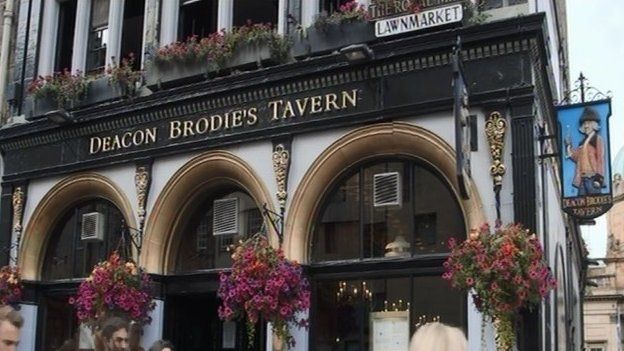
Deacon Brodie

Deacon Brodie's Pub is a popular watering hole on the Royal Mile in Edinburgh.
But who was Deacon Brodie?
This story is unashamedly borrowed from a BBC article about him.


On 1 October 1788 William Brodie was hanged for theft in the Lawnmarket, Edinburgh, in front of a crowd that was the largest seen in living memory. He strode out to the gallows in fine clothes and a powdered wig. He was 47 when he was hanged and until his arrest had managed to maintain the illusion of being a respectable craftsman.

The prestigious title of deacon did not refer to religion, as many assume, but instead to his presidency of one of Edinburgh's trades guilds. His trade was a cabinet-maker and his position as deacon of the Incorporation of Wrights made him a member of the town council.

pubPossibly Brodie's double life was the inspiration for Edinburgh author Robert Louis Stevenson's infamous character Dr Jekyll and Mr Hyde, which was published a century later.

Both Brodie's grandfathers were renowned Edinburgh lawyers and his father was a successful businessman. Brodie himself was a fine craftsman specialising in domestic furniture such a cupboards and cabinets. He was also a talented locksmith. Through his work he had access to the houses of very rich people and was able to make impressions of keys which meant he could come back at night and rob them. His criminal career began in 1768 when he copied keys to a bank door and stole £800, enough to maintain a household for several years. But it was not until more than a decade later that Brodie's crime spree got going properly.

Brodie's father died of palsy in 1782 and left him £10,000 in cash alone, a fortune in those days, plus at least four houses and the business. Brodie had been a member of The Cape, the most exclusive club in Edinburgh, but over time his interests turned to a disreputable tavern in Fleshmarket Close, which was notorious for late-night drinking and gambling with cards and dice. He was also keen on betting on cock fighting. In addition to his gambling, he was also supporting two mistresses (who didn't know each other!) and five children. He ran up debts during the night but his daytime business was thriving

In the summer of 1786 Brodie met an Englishman, George Smith, a locksmith who ran a grocers shop in the Cowgate. The pair soon became extremely busy targeting businesses and private homes in the Old Town. Towards the end of 1786 Brodie and Smith robbed a goldsmith's and a tobacconist's. On Christmas Eve they made off with a major haul from Bruce Brothers, including watches, rings and lockets. Before long they got involved with two more criminals, John Brown, a thief on the run from a seven year sentence of transportation, and Andrew Ainslie, a shoemaker.

By the summer of 1787 they had ventured further afield to Leith where they stole tea, a valuable commodity at the time, from a grocer's shop. Shortly after this they stole the ceremonial mace from the University of Edinburgh.

The Excise Office in Edinburgh was in Chessel's Court at the bottom of the Royal Mile. For this job, possibly for the first time, the gang were armed with pistols and, also unusually for them, they broke in. They were disturbed and fled with just £16. It was a disaster and it led to the gang falling out

John Brown was tempted by the reward of £150 being offered for information about a previous robbery and went to the sheriff's clerk to name Ainslie and Smith as the culprits. When they were arrested Brodie feared the game was up and prepared to disappear. He took the stagecoach to London and then a ship to Holland. But the reward for Brodie's capture led to him being tracked down and discovered as he hid in a cupboard in an inn. He was returned to Edinburgh where he stood trial with Smith. His trial lasted just 21 hours. He was hanged in front of a crowd of 40,000.


According to a legend, Brodie wore a steel collar and silver tube in his throat to prevent the hanging from being fatal. It was said that he had bribed the hangman to ignore it and arranged for his body to be removed quickly in the hope that he could later be revived. If so, the plan failed. Brodie was buried in an unmarked grave at the Buccleuch Church in Chapel Street. The ground is now covered by a car park behind university lecture halls. However, rumours of his being seen in Paris circulated later and gave the story of his scheme to evade death further publicity.

Saturday, 11 August 2018

Edinburgh 3

The Scottish Parliament Building was opened by Queen Elizabeth II in October 2004. The building was designed by Spanish architect Enric Miralles. Some of the principal features of the complex include leaf-shaped buildings, a grass-roofed branch merging into adjacent parkland and gabion walls formed from the stones of previous buildings. It is located in the Holyrood neighbourhood of Edinburgh.


The Scottish Parliament is a democratically elected body comprising 129 members known as Members of the Scottish Parliament (MSPs), elected for four-year terms under the additional member system: 73 MSPs represent individual geographical constituencies elected by the plurality ("first past the post") system, while a further 56 are returned from eight additional member regions, each electing seven MSPs. The most recent general election to the Parliament was held on 5 May 2016, with the Scottish National Party winning a plurality.


Just down the road at the bottom of the Royal Mile is the Palace of Holyroodhouse, the Queen's official residence in Edinburgh. Queen Elizabeth was actually in residence when I was there. She was holding one of her fancy garden parties, but sadly my personal invitation must have been lost in the mail. Just as well, as I didn't bring my fascinator headgear with me.

The local police were very much in evidence outside the walls of the Palace.
A couple of the partygoers. Most of the men were in full Highland dress, kilts and all. Very smart.
The Palace is normally open to the paying public, but closed when the Queen is in residence, but we could still go into the gift shop and see what souvenirs Her Majesty has to offer. This embroidered velvet cushion would grace your sofa for the princely sum of 99 pounds....that's around $165 Canadian.
And who could possibly resist these sweet little Royal corgis?
Nope, I didn't buy one.

Wednesday, 8 August 2018

Edinburgh 2

Edinburgh is hilly! I was always either walking uphill or downhill, very good for the legs! But it was HOT weather.... almost too hot. Lots of opportunities to stop for a cold beer.
There are some very scenic alleyways connecting the back streets. I would have liked to have more time to explore. Some photos....


The Scott Monument is a Victorian Gothic monument to Scotland's best-loved author Sir Walter Scott (1771-1832). It is the second largest monument to a writer in the world, and was built in Princes Street Gardens, completed after 4 years of construction in 1844. The story of the Monument is told in the Museum Room on the first floor. 

The Scott Monument was designed by George Meikle Kemp (1795-1844), but sadly Kemp did not see his design completed as he drowned in the Union Canal when the Monument was only half completed.
The tower is just over 61m high, and has a series of viewing platforms reached by a series of narrow spiral staircases. The highest platform is reached by 288 steps. The Monument is  rather rudely known as the Gothic Rocket! No, I didn't go up, but I wish I had. Too busy doing other sightseeing. Maybe next time. (I hope there is a next time, Edinburgh is lovely!)
A white Italian Carrera marble statue of Sir Walter Scott and his deerhound, Maida, is located at the base of the Monument. There are 68 figurative statues on the monument of which 64 are visible from the ground. Each figure represents a famous Scottish person or a character from Scott's literary work. Four figures are placed above the final viewing gallery and are only visible by telephoto or (at a very distorted angle) from the viewing gallery itself. 

The Monument was constructed of Binny sandstone from the local Ecclesmachan quarry in West Lothian. As it is a dark oily stone it has prematurely aged the appearance of the structure, although the soot of Victorian times and today's exhaust fumes contribute to the dark colour.